". . .the word of God is not bound." II Tim. 2:9b

Showing posts with label supplies. Show all posts

Sunday, July 3, 2016

Unstructured Play Week, Day 4, Part 2: Finger Paint Is Everywhere!

"For we are God’s handiwork, created in Christ Jesus to do good works, which God prepared in advance for us to do." Ephesians 2:10 NIV

By my daughter, age 11
Welcome to Day 4, Part 2 of Unstructured Play Week at Christian Teacher, Public School. Earlier I listed my 12 Tips for Adults in the Lives of Kids who are Artists. Now it's time to really make a splash, with finger paints!

Finger painting is a rare treat for preschool kids because the adults in their lives are afraid of the mess. When doing art with my preschool son, I sometimes underestimate the time it will take, the mess it will make, and the fun he will have! Finger painting falls under Unstructured Play because kids get to call the shots. Don't give them patterns. Don't show them examples of finished work. Just get your hands in the paint and have fun. The art will follow.

The Paint
Ordinarily, I steer clear of washable paints for school and home use because the colors tend to be less vibrant. When I taught kindergarten, I recommended Prang watercolors because there's a noticeable difference in brightness. When it comes to finger painting, though, washable, non-toxic paint is the way to go. Right now my kids use Rich Art's Clear Colors Washable Tempera Paints in primary colors that mix well to form other colors. When dry on the paper they're not as bright as I'd expected, but they do the job. Another option? Make your own finger paints.

The Paper
I bought Pacon Finger Paint Art Paper in a big, messy masterpiece-friendly 11" x 16." It's not too pricey, and it's worth the investment to get the best look from the paint and make sure the paper won't deteriorate.

Other Supplies and Prep
Even with washable paint, you need some type of smock (an old tee shirt that's a few sizes too big is perfect) or apron. To protect surfaces, lay down newspaper, and have paper towels handy to help with cleanup. Use paper plates to hold the paint while in use. You'll also need to designate a safe, flat surface for finished artwork to dry.


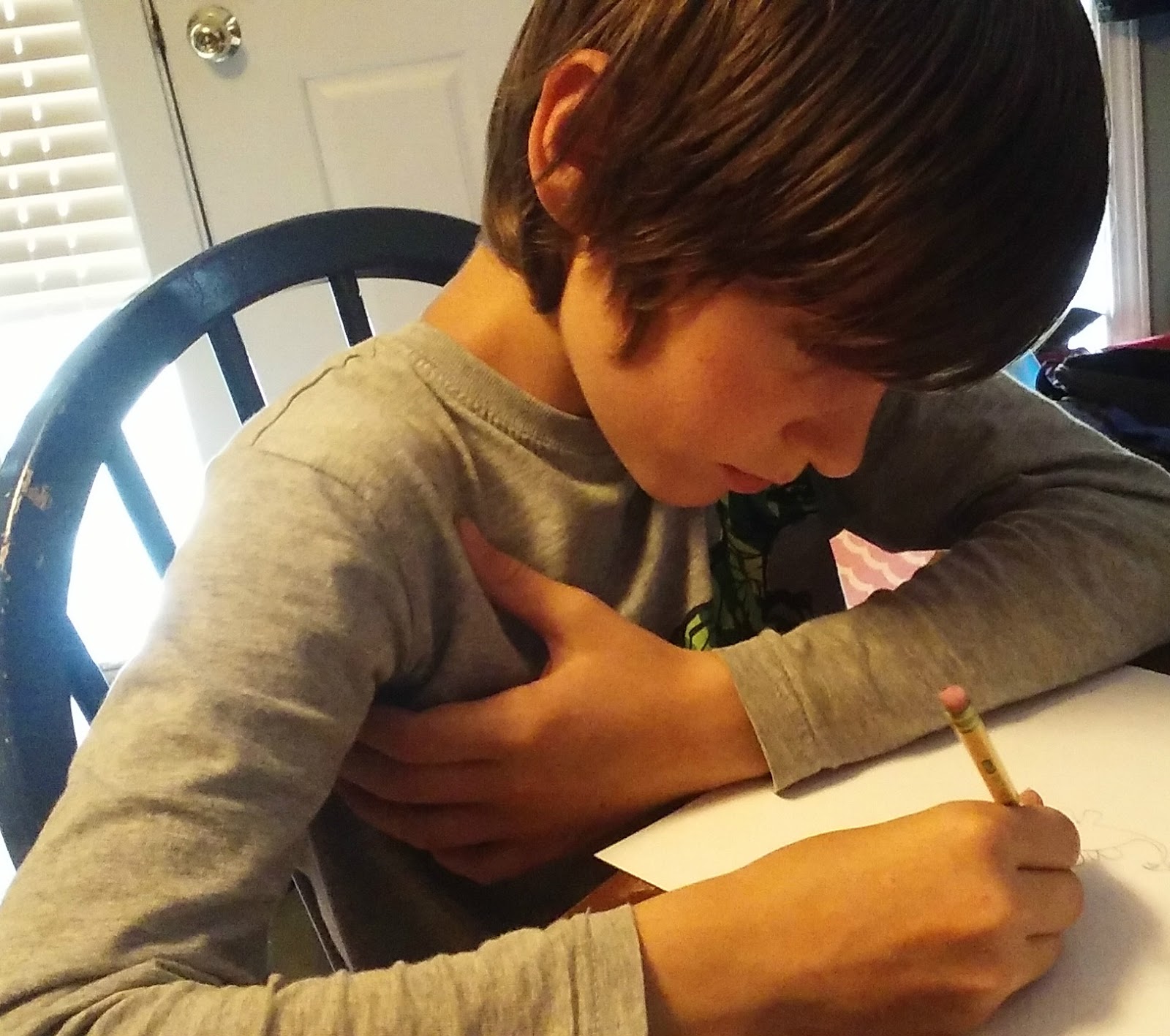
 After a few unexpected days off, we finally broke out the finger paints at the kitchen table. My daughter, eleven, is more comfortable than the boys are with getting her fingers messy for the sake of art. She focused on abstract paint application techniques and not on a specific theme or subject.


Vampire painting by my middle son
My middle son, nine years old and more reserved, painted a vampire. His inspiration was a favorite video game he's been missing since our family has opted for a "Privilege-Free Summer." We're trying to get the kids outside more and get them reading. It's been good to be able to sit down with the kids for Bible story reading and prayer more regularly.


The youngest, age four, was also hesitant to get his fingers messy. How blessed am I to have kids who wash their hands! But he dipped a finger in the black paint and soon got started. His favorite art subject is super heroes. I'm glad I took a picture of his painting before he decided to slop water on it with a paper towel!

Super Heroes
This picture is of "Super heroes doing the things that they like to do." It's fun to ask kids to tell you about their artwork. Sometimes you get a whole story to go with it.

I hope this post has been fun, and that it encourages you to include unstructured play time in your children's and your students' day. If you haven't read the other posts in the series, here are the links again. Please leave a comment and share! And happy Independence Day.

Unstructured Play Week
Day 1 Paper dolls
Day 2 Kitchen Chemistry and Cooking
Day 3 A Hike Up the Creek
Day 4, Part 1 Every Child an Artist, including 12 Suggestions for Grown-ups in the Lives of Young Artists


Coloring Books to Relax

Wednesday, June 29, 2016

Unstructured Play Week, Day 4, Part 1: Every Child an Artist

"He has made everything beautiful in its time." Ecclesiastes 3:11 ESV

Welcome back to Unstructured Play Week on Christian Teacher, Public School! Yesterday we rambled through the alfalfa field to a sandy beach in the middle of an Idaho creek. Today, we do art!

By my daughter, then three years old
My daughter's first artistic attempts came at age three, when she scribbled geometric shapes and named them like people. She loved birds, especially swans and ducks, so as her drawing skills developed, she often drew waterfowl. She went through reams of paper, usually leaving her work strewn about the house for her parents to gather up later. She was a living embodiment of the phrase "Practice makes perfect." Hundreds of papers, each with a single swan in black ball-point pen.


Blue Jay
When she was small, she didn't gravitate toward coloring books, which turned out fine because she learned to draw instead of learning to fill in predetermined forms. Now, she enjoys coloring books, too. The blue jay and Baltimore orioles at left are some of her recent coloring ventures from Dover Publications' Fifty Favorite Birds coloring book by Lisa Bonforte.


My middle son drawing
Today, all three of my children draw and paint. Two of them write and illustrate their own games, graphic novels and comics. Lest you think my children unusual, Picasso famously said that every child is an artist; the trick is for him to remain an artist when he grows up.


Baltimore Oriole
So what can we, as teachers and parents, do to fan the flames of the little artists in our lives? What I know on this subject has come to me through trial and error and through the never ending joy of having children who draw. The following tips will help you keep art unstructured and playful.


Twelve Suggestions for Grown-ups in the Lives of Young Artists:
  1. Don't criticize. (You might be thinking, "You mean 'Don't criticize much.'" No. I mean, "Don't criticize." Let the artist grow first. It doesn't mean you have to praise every effort highly. Simply nurture. You don't prune a sprout). 
  2. Nurture resilience: artists grow by failing and trying again.
  3. Be sincere.
  4. Find the good and engage with it. When a child presents you with a drawing of a clearly human yet ill-formed creature with scraggly hair and no nose, it's time to say "Now, I should recognize this person, shouldn't I? Look at that big smile!" instead of "Who is that supposed to be?" (Note, it might be a drawing of you, so be careful!)
  5. Teach children to observe. Simply seeing the world around them is the most important skill kids can learn if they wish to pursue art.
  6. Allow derivative work. A child draws a scene from My Little Pony or Angry Birds. Should you freak out because of copyright violation? No. The child is not going to sell the work. When it's time to go pro, then emphasize originality.
  7. Provide the tools. You are the one with the classroom supply budget (I hope you have a good
    By my son, age 9
    one!) or the wallet. Maybe you can't afford an array of glorious new art supplies, but you can buy a box of crayons or a tray of watercolor paints. If you are able to provide more, also make provision for storage.
  8. Help with the cleanup. This means training the child to clean up after him- or herself, and then stepping up to assist when needed. The training part is tedious, but neglect it to your peril.
  9. Be calm when some aspect of the art adventure gets out of hand. It sends a mixed message to kids when one minute you're praising their drawing and the next you're yelling at them for making a mess. Send one message all the time: "I love that you love art!" For Christians, it helps to keep in mind that God is the Creator; a child's creativity is a reflection of God's power and beauty. Be still.
  10. Help find display venues; supply hardware and help.
  11. Recognize talent. There may be that one student in a class of twenty-five who clearly needs to be an artist. Do your part to help ensure art stays in his or her life for the long haul.
  12. Refer to the child as an artist, not a child who "wants to be an artist."
By my daughter at age 11
Addendum to #5 above: Have you ever been to an indie art supply store? The sights! The smells! Take the artist-child and get thee to an art supply store!

If you know more ways parents and teachers can encourage children who are artists, please share them! 

And check back later today for Part 2 of Every Child an Artist, when we break out the finger paint!