". . .the word of God is not bound." II Tim. 2:9b

Showing posts with label birds. Show all posts

Monday, January 23, 2017

New Kindle eBook: The Swans of Starlight Lake

ebook, kindle, swans, birds, Amy Ballard, kids, fairy tale, story, book, new, fiction
The Swans of Starlight Lake
When my daughter was very small, she began drawing ducks and swans, teaching herself to draw by constant practice. We had printer paper all over the house—drafts of swan necks and wings, nests, eggs, swans in flight, nesting swans, swans on water, frightened swans, and proud mother swans with newly-hatched eggs.

Today I feel like one of those proud mother swans. My daughter and I have self-published a fairy tale we wrote together—about swans, of course. The Swans of Starlight Lake began as a bedtime story, evolved into an ebook typed and illustrated for our own enjoyment, and now comes into its own as a Kindle edition.
kindle, children's, kids, books, fairy tales, nest, birds, swans, feathers, girl power, hero, adventure, castle, princess

With fairy-tale tradition entwined throughout, this new story by a mother-daughter team is a classic tale of adventure and love.

Readers ages 5-10 will wonder what's going to happen next as Muriel, Leo, and their mother set out to rescue two stolen swan eggs from a reclusive noble who hides beneath a feathered cape. The kids work together to thwart the guards and bring their treasure safely home to Starlight Lake.

The Swans of Starlight Lake contains several vintage, color illustrations and has a 14-point font for little eyes. Get it for Kindle for .99¢, or free with Kindle Unlimited.

If you read the story, please consider leaving a review on Amazon.com and using social media buttons to share. Thanks for helping our story reach a wider audience!

Wednesday, June 29, 2016

Unstructured Play Week, Day 4, Part 1: Every Child an Artist

"He has made everything beautiful in its time." Ecclesiastes 3:11 ESV

Welcome back to Unstructured Play Week on Christian Teacher, Public School! Yesterday we rambled through the alfalfa field to a sandy beach in the middle of an Idaho creek. Today, we do art!

By my daughter, then three years old
My daughter's first artistic attempts came at age three, when she scribbled geometric shapes and named them like people. She loved birds, especially swans and ducks, so as her drawing skills developed, she often drew waterfowl. She went through reams of paper, usually leaving her work strewn about the house for her parents to gather up later. She was a living embodiment of the phrase "Practice makes perfect." Hundreds of papers, each with a single swan in black ball-point pen.


Blue Jay
When she was small, she didn't gravitate toward coloring books, which turned out fine because she learned to draw instead of learning to fill in predetermined forms. Now, she enjoys coloring books, too. The blue jay and Baltimore orioles at left are some of her recent coloring ventures from Dover Publications' Fifty Favorite Birds coloring book by Lisa Bonforte.


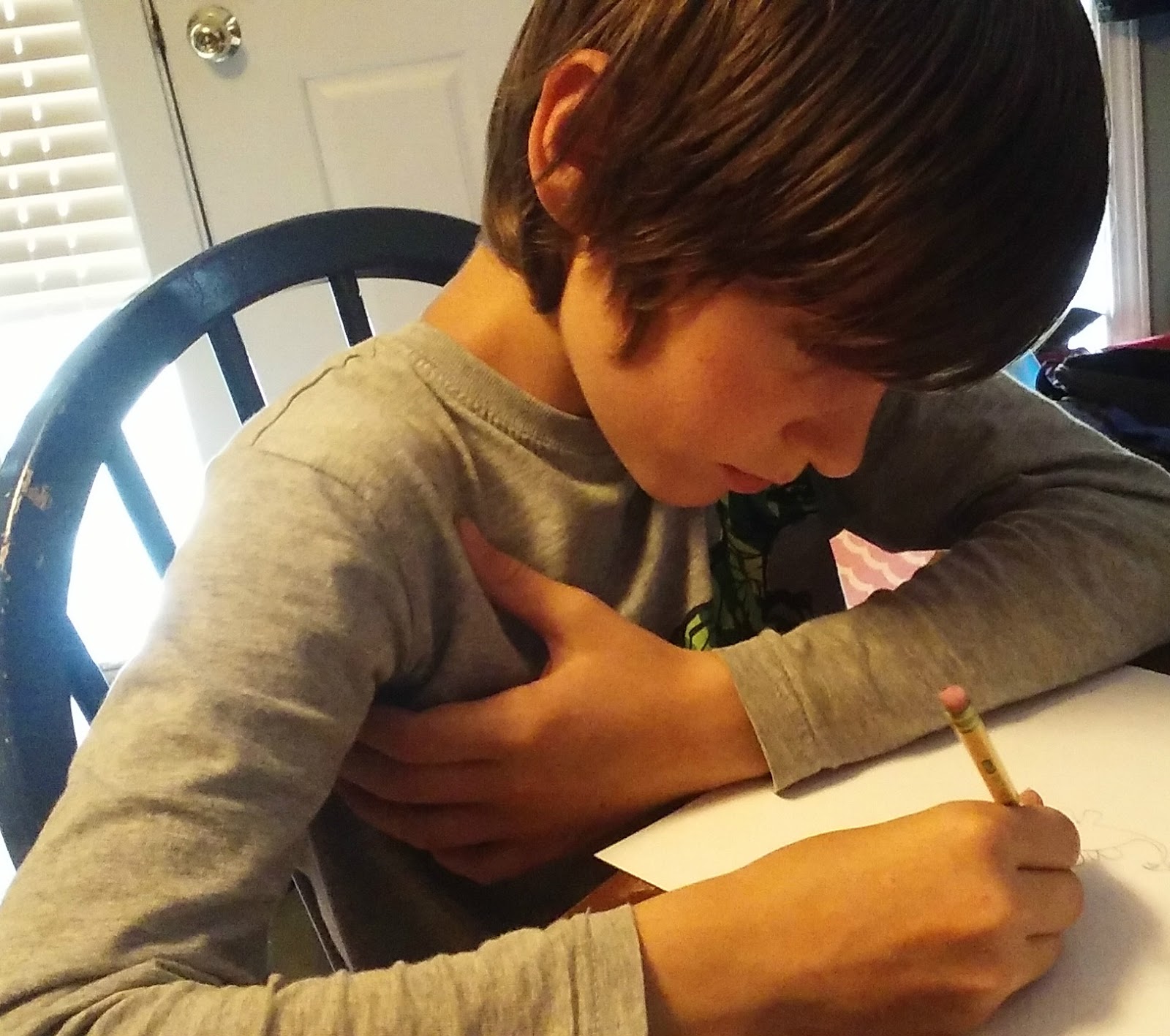
My middle son drawing
Today, all three of my children draw and paint. Two of them write and illustrate their own games, graphic novels and comics. Lest you think my children unusual, Picasso famously said that every child is an artist; the trick is for him to remain an artist when he grows up.


Baltimore Oriole
So what can we, as teachers and parents, do to fan the flames of the little artists in our lives? What I know on this subject has come to me through trial and error and through the never ending joy of having children who draw. The following tips will help you keep art unstructured and playful.


Twelve Suggestions for Grown-ups in the Lives of Young Artists:
  1. Don't criticize. (You might be thinking, "You mean 'Don't criticize much.'" No. I mean, "Don't criticize." Let the artist grow first. It doesn't mean you have to praise every effort highly. Simply nurture. You don't prune a sprout). 
  2. Nurture resilience: artists grow by failing and trying again.
  3. Be sincere.
  4. Find the good and engage with it. When a child presents you with a drawing of a clearly human yet ill-formed creature with scraggly hair and no nose, it's time to say "Now, I should recognize this person, shouldn't I? Look at that big smile!" instead of "Who is that supposed to be?" (Note, it might be a drawing of you, so be careful!)
  5. Teach children to observe. Simply seeing the world around them is the most important skill kids can learn if they wish to pursue art.
  6. Allow derivative work. A child draws a scene from My Little Pony or Angry Birds. Should you freak out because of copyright violation? No. The child is not going to sell the work. When it's time to go pro, then emphasize originality.
  7. Provide the tools. You are the one with the classroom supply budget (I hope you have a good
    By my son, age 9
    one!) or the wallet. Maybe you can't afford an array of glorious new art supplies, but you can buy a box of crayons or a tray of watercolor paints. If you are able to provide more, also make provision for storage.
  8. Help with the cleanup. This means training the child to clean up after him- or herself, and then stepping up to assist when needed. The training part is tedious, but neglect it to your peril.
  9. Be calm when some aspect of the art adventure gets out of hand. It sends a mixed message to kids when one minute you're praising their drawing and the next you're yelling at them for making a mess. Send one message all the time: "I love that you love art!" For Christians, it helps to keep in mind that God is the Creator; a child's creativity is a reflection of God's power and beauty. Be still.
  10. Help find display venues; supply hardware and help.
  11. Recognize talent. There may be that one student in a class of twenty-five who clearly needs to be an artist. Do your part to help ensure art stays in his or her life for the long haul.
  12. Refer to the child as an artist, not a child who "wants to be an artist."
By my daughter at age 11
Addendum to #5 above: Have you ever been to an indie art supply store? The sights! The smells! Take the artist-child and get thee to an art supply store!

If you know more ways parents and teachers can encourage children who are artists, please share them! 

And check back later today for Part 2 of Every Child an Artist, when we break out the finger paint!

Tuesday, June 28, 2016

Unstructured Play Week, Day 3: A Hike Up the Creek

"The earth is full of Thy lovingkindness, O Lord; Teach me Thy statutes." Psalm 119:64

The creek runs along the edge of an alfalfa field near town. Photos by Amy Ballard.

Welcome to Day 3 of Unstructured Play Week! Yesterday we played in the kitchen. Today we hike up the creek in rural Idaho for endless, unscripted play in the water, sand, mud, trees, and sun. Hope you brought your sun glasses and water shoes!

Recently, stories have circulated on Facebook and elsewhere asserting that American schools think recess is a waste of time, while schools in Europe often send students outdoors for unstructured, hands-on play time in nature. The stories smack of propaganda, but they are still a springboard for discussion.

There is an undeniable body of evidence that kids need to get outdoors and to have free play. One source that eloquently argues for getting kids out into nature is the Child Mind Institute. Cited benefits of time outdoors include building confidence and creativity, providing different stimulation, getting kids moving, making them think, and reducing stress and fatigue. All of this can happen through play, without adult-imposed structure or set learning objectives.

Here in southern Idaho, there are many creeks that run down out of the mountains toward larger streams and eventually to the Snake River and the Pacific. They provide a glorious playground for fishing, swimming, canoeing, kayaking, rafting, and other hobbies. But there are simpler ways to while away a sunny day at the creek, and kids know how to find them.

Makeshift minnow bucket
Recently, my children and I took two excursions up the creek near our home. We had so much fun the first time that we invited cousins on the second trip.

My daughter caught minnows in a bucket the first day, but when we forgot the bucket the next day, she had to make do with (ironically) a Swedish Fish bag. It worked just fine. She later released the little fishies back into the wild.

She and her cousins also made tiny houses out of rocks, mud, and decorative grass, moss, feathers, and flowers they found in the woods around our little beach. Each child expressed a different architectural bent and decorative flair.


Mud houses in the making
Meanwhile, the youngest two of our crew sat in a shady part of the creek and played with mud contentedly in their own private hot tub.


Cheeto the walking stick
Kids love playing creatively with sticks. On the first day at the creek, my youngest son adopted a walking stick and inexplicably named it "Cheeto." Later, he began digging for dinosaur bones (rocks) and identifying his finds. "This is a velociraptor tooth! Here's where it attaches to the gum, and here's where it cuts up the meat!"

We took time for simply enjoying nature, too. In the soft mud at the edge of the creek, duck and raccoon prints spoke of recent animal visits. The kids spotted birds in the air above us, including prairie falcons and yellow-headed blackbirds, and my daughter spied a duck hiding in a shady bend in the creek.

Wild flowers
There were wildflowers like yellow sweet-clover all around, and of course, the low, scrubby willows that are everywhere along Idaho's streams. What better place to spend a summer afternoon?


More wildflowers
Of course, not everyone lives in a rural area, so it can be more challenging to find a place for kids to play freely in nature. Chances are, you've already scouted out the local parks. Have you tried picnic areas beside rivers, streams, and lakes in or near your city?

Or maybe it's time to plan an outing just a few hours from home so the kids can sink their toes into the mud, hear the wind in the trees, and forget about technology for a while.

Fun by the creek
Although I'm not what you'd call a tree hugger or a hippie, I did grow up in the woods of Maine and can attest to the tranquility and happiness of time spent in the natural world. I hope that as parents and teachers and Christians we'll all head out into nature often, both to give children more and better opportunities for unstructured play and for our own reflection.

The Bible often speaks of the beauty of Creation and how everything that was made praises God. In just one example, Job 12:7-10 says,
“But now ask the beasts, and let them teach you; And the birds of the heavens, and let them tell you. Or speak to the earth, and let it teach you; And let the fish of the sea declare to you. Who among all these does not know That the hand of the Lord has done this, In whose hand is the life of every living thing, And the breath of all mankind?"
American naturalist John Burroughs reflected,
"I go to nature to be soothed and healed, and to have my senses put in order."
Today, kids and teachers alike are desperate for that kind of low-tech recharge.

Come back tomorrow for more on unstructured play, this time in the vivid world of art.

The Field and Forest Handy Book