". . .the word of God is not bound." II Tim. 2:9b

Showing posts with label ELA. Show all posts

Sunday, February 7, 2021

What Must Be Taught In Reading Instruction?

There are lots of things that get teachers excited. Lightbulbs going on, trend lines on a graph going up, rapport being cemented, the smell of the first sharpened pencil of the new school year. . . .

Ranking right up there in the top thrills of a teacher's career is collaborating with a great team to choose new curriculum.

At my district, I inherited literature textbooks that were published in 2007. There were no consumables, and we didn't have access to online resources now offered by the publisher to districts that purchase brand-new curriculum. That has meant a lot of reinventing the wheel, aligning outdated texts to new standards, and even consulting Teachers Pay Teachers for quick answers. Throw in three sessions in quarantine due to COVID outbreaks, and the existing resources' deficiencies became that much more glaring.

So it's easy to see why new curriculum on the horizon is a matter for celebration. I'm eager to have resources at my fingertips to help me meet the needs of individual learners. I can't wait to get my hands on standards-aligned, research-based lessons and their corresponding assessments. I want online everything, alongside traditional textbooks so learners can access texts from home or at school, in a format that works best for them.

As we gear up to examine what exactly we are looking for in a reading/ELA curriculum, my administrator has arranged for a half-day intensive workshop (okay, she billed it as a party) to help focus our quest.

And there's homework! Each team member received curriculum samples from one publisher, with more on the way, to review ahead of the session. And we're reading an article on the Science of Reading by Laura Stuart, National Director for The Reading League. You can find it on the Zaner-Bloser Science of Reading Hub.

In the article, Stuart spells out answers to the burning question, "What must be taught?" Synthesizing current studies on how children learn to read, there are five essential components of reading that must be taught, as Stuart says, "thoroughly and skillfully." These are: phonemic awareness, phonics, fluent text reading, vocabulary, and comprehension. 

Stuart explains each component briefly before going on to offer evidence-based principles of instruction, or, the nuts and bolts of  "How to teach it."

I'm excited to see what my colleagues bring to the discussion after reading our homework and browsing curriculum samples. And I'm wondering, how might our collaboration on February 12 change the way we teach, even before we choose new curriculum? 


Also Read:

Using Mentor Texts to Teach Writing and Enhance Creativity

Presenting a Lively Professional Development: Strategies for Teaching English Language Learners

Thursday, July 12, 2018

A little bit of mystery

". . .how much happier that man is who believes his native town to be the world, than he who aspires to become greater than his nature will allow."

Seems like a funny quote for a teacher to post.

Don't we want our students to learn of the world, to understand that their native town is not all there is?

And what's this about "than his nature will allow"?

Where does this quote come from, anyway?

Great questons. The kind of questions we want students asking. The kind that comes from mystery, omitted information, suspense. The kind that leads to deep understanding of a text like. . .drumroll. . .Frankenstein by Mary Shelley.

Okay, Frankenstein has been on my To-Read list for. . .a lifetime. After reading Romantic Outlaws: The Extraordinary Lives of Mary Wollstonecraft and Her Daughter Mary Shelley, I moved Frankenstein to my To-Read-This-Summer-If-I-Have-Time list. There it sat.

Then I went to the (most fun ever!) P20 Educator Conference this week and attended Laurie Roberts's fantastic session entitled "Why Don't They Read? Leveraging the Power of Mystery." I knew this would be a powerful session for me because

  • Laurie is a fellow-Idaho Core Teacher Network alum
  • My students need all the help they can get when it comes to reading literature
  • I need all the help I can get to hook kids on reading
  • I love improving the way I approach teaching literature
  • Adding mystery and suspense to anything is always a good move
  • Laurie is an awesome presenter (did I already mention that?)

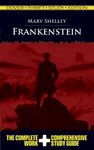
Lo and behold, in her session, Laurie unfolded an adaptation of the Document-Based-Inquiry (DBI) process using none other than Mary Shelley's Frankenstein, now in its 200th year of publication. She engaged us with the text right off the bat by having us read the first letter Robert Walton writes to his sister in the opening pages of the novel.

Frankenstein Thrift Study Edition

How was that mysterious and/or suspenseful? The mystery was organic, since most of us had no context other than the paper in our hands and the vague notions of the plot of Frankenstein we had garnered from pop culture. Even as we read silently for eight full minutes of dense pre-Victorian text, the story began to work its magic on us. Laurie had provided a notecatcher for recording notices, wonders, and predictions, so we scribbled away as we read.

Why did his father not want him to go to sea? I wondered.

This text is straight-up Romantic Era literature, I noticed. The second paragraph is full of descriptions of nature, and the whole thing emphasizes emotion.

I'm a slow reader, so I didn't finish in eight minutes, but I couldn't wait to read the rest of it later. In the meantime, Laurie gave us time to discuss within small groups. My group included three other teachers, two of whom consider themselves avid readers and one who considers herself a reluctant reader. We took turns sharing what we'd noticed, wondered, and predicted while reading.

Each of us took something different away from the reading, while of course there were overlaps, too. I shared that I had at first struggled to figure out the object of Robert Walton's explorations. Another teacher shared that she had noticed the emotional highs and lows that Walton experienced. We nominated her to share out to the whole class when Laurie moved on to calling on each group

As I listened to the many perspectives on the pages we had read, I thought how powerfully the process fostered peer-to-peer instruction. Laurie wasn't teaching us Frankenstein. We were teaching us Frankenstein.

Needless to say, I was mentally moving the novel to my Must-At-All-Costs-Read-As-Soon-As-I-Get-Home-From-This-Conference shelf!

Frankenstein

In her AP Literature classes at Timberline High School in Boise, Laurie repeats the 8-minute reading, note-taking, and discussion process with the other letters from the prologue of the novel. Notecatchers typically aren't graded. Each new letter adds layers of meaning, new information, sparking new notices, wonders, and predictions.

Where's the monster? Isn't there suposed to be a monster?

This expedition is not going to end well.

I said at the beginning that this process is an adaptation of the DBI process. A typical Document-Based-Inquiry begins with accessible texts that may be in video, audio, or image form. The process then moves into more informative, more complex text forms that add the next layer of meaning. A third and final round of documents may include texts that help students synthesize what they have learned. What Laurie did with Frankenstein was get readers hooked on the text itself, rather than potentially distracting or boring them by lecturing about the author, showing a PowerPoint, or otherwise "introducing the text." There's no need. You can do that stuff later if you need to. The suspense is in the text, if we'll just tap into it.

Now I'm several chapters into the novel. The anticipation I built by reading Romantic Outlaws and attending Laurie's session is being fulfilled on every page. I only hope I can hook students on literature as effectively in my classroom.

Thanks, Laurie!


Want more?
Follow Laurie on Twitter @lauriedroberts.
Here's an awesome exemplar DBI that a teacher in the Idaho Core Teacher Network created.
I share my process of revising my Band of Brothers unit, which includes a DBI, here.
Follow me, Amy Ballard, on Goodreads.

Saturday, August 20, 2016

A Student-Friendly Checklist for 9th and 10th Grade ELA Writing

It's challenging to find user-friendly checklists for the Common Core standards. This year I've been playing around with some formats to help my students keep track of how they're doing. Here's my new student-friendly checklist for 9th and 10th grade ELA writing standards as a Google doc. I plan to use the same format to create check lists for the other standard sets I teach.

Obviously, teaching something once is not enough to merit a check mark. How has the student demonstrated understanding of the concept? For a brush-up on assessing understanding, read Edutopia's excellent article, 'What Exactly Is "Understanding?" And How Do We Assess It?'

Have a great resource to help teachers and students track understanding? Please share!

Saturday, July 9, 2016

Leadership in Band of Brothers Unit

Now available from Brevity on TPT
It's been about a year in the making, but my Leadership in Band of Brothers unit is finally complete. Writing a Common Core-aligned unit was the main requirement of the Idaho Coaching Network class I took throughout the last school year, and my unit for the class was inspired by binge-watching the documentary film series Band of Brothers with my husband. While I wasn't sure some of the material in the film itself would be appropriate to show in class, I knew that the story of the 101st Airborne and Easy Company would be highly engaging to my sophomores.

The motif of Leadership often comes up in everyday conversations with high school students, not just when it's prompted by literature studies. Kids want to be leaders, and they need vivid examples of real-life leaders to emulate. Maj. Richard "Dick" Winters of Easy Company fills those shoes perfectly. Leadership in Band of Brothers gives students the opportunity to learn from the D-Day heroism of Winters and his men and to reflect upon leadership traits in their own lives.

I test drove the rough draft of the unit this past spring with success, though some areas needed to be revised afterward. Now the revision is done, and it's finally time to make the unit available on Teachers Pay Teachers! I feel like a proud Mama.

Here's a snippet from the TPT description:

Designed for 10th grade Social Studies or ELA classes, the plan is ten pages with links to some 30 additional pages of materials. Students will read Chapters 1-5 of Stephen E. Ambrose's bestselling nonfiction book Band of Brothers, the basis for the documentary film series. Students will also engage in learning activities such as Document Based Inquiry, close reading, script writing, reflective self-survey, and recording a radio broadcast.
Classroom tested, Common Core aligned, and ready to teach. All you need to provide is the book Band of Brothers or access to the first five chapters. High quality unit lasts three weeks or more and pairs well with other WWII readings such as The Book Thief.

I hope the unit finds a home in lots of Social Studies and ELA classrooms. Now to finish prepping for conference day! Have a great weekend.

Sunday, May 22, 2016

Teaching Literary Elements with Famous Shakespearean Quotes

Famous quotes from Julius Caesar

Before I introduce a Shakespeare play to any of my classes, I familiarize students with some of the famous quotes from the play. In addition to giving them a glimpse of what's ahead and building anticipation, it's an opportunity to teach literary elements. I start as much as a semester before reading the play in class.

Famous quotes from Macbeth

Students enjoy memorizing short, easy quotes, especially since many Shakespearean quotes are already familiar from movies and cartoons. As a bonus, when you later read the play, the quotes appear in context. It's like meeting up with an old friend.

Visit my Teachers Pay Teachers store, Brevity, to purchase the wall docs for quotes from Romeo and Juliet, Macbeth, and Julius Caesar.

Kindergarten, First, Second, Third, Fourth, Fifth, Sixth, Seventh, Eighth, Ninth, Tenth, Eleventh, Twelfth, Homeschooler, Not Grade Specific - TeachersPayTeachers.com