". . .the word of God is not bound." II Tim. 2:9b

Showing posts with label Powerful Teaching. Show all posts

Tuesday, January 14, 2020

Presenting a Lively Professional Development: Strategies for Teaching English Language Learners


In 2016, the percentage of Idaho public school students who were English Language Learners was 5.4, nothing to California's 20.2 (National Center for Education Statistics). Still, teachers in small rural schools in Idaho and elsewhere may feel lost when it comes to supporting ELs in their classes.

Where can teachers get help? What do teachers need to know?

When my tiny school enrolled a Spanish-only student two years ago (see my previous post, Be Unforgettable to English Language Learners), I knew my training was not adequate to meet her learning needs. Happily, my administrator asked me to take a colleague and attend a one-day session on Go-To Strategies for teaching English learners. The training was presented by the Idaho State Dept. of Education's Title III Consortium using a toolkit developed in Missouri by Linda New Levine, Laura Lukens, and Betty Ansin Smallwood.

During the training, participants test-drove dozens of strategies and watched the presenters model the approaches they offered. My favorite strategy had to be Roving Charts, which works like this:

Purpose: To activate prior knowledge; to level the playing field for all learners; to allow learners to teach each other; to promote oral language

Grouping Format: Interactive small groups

Strategy Basics:
1. Divide students into groups
2. Teacher presents a concept, question, or problem
3. Group members brainstorm and write ideas on graphic organizer chart
4. One student “rover” passes chart to next group [Play up-tempo music during passing!]
5. That group brainstorms more ideas on chart
6. Rover returns the chart to original group; group discusses information gained
7. Whole-group discussion

Remember to have students sign their charts and to use for formative assessment as appropriate.


When my colleague and I returned from the training, we built a PD for our staff and presented it, passing on what we learned in a "teach the teacher" opportunity. We got our teachers up and moving (roving charts!) and put strategies in their hands to support all learners, not just ELs. The response was overwhelmingly positive.

This year, I'm presenting a similar session to the staff, which includes some new faces this year. As an added twist, I'm incorporating some of the cognitive science "Power Tools" I've gleaned from the awesome, must-read book Powerful Teaching: Unleash the Science of Learning, which I just finished reading. That means I'm including opportunities for staff to retrieve prior learning, to receive spaced practice, and to receive elaborative feedback. Their metacognition, or thinking about thinking, will help ensure long-term learning and transfer. Meaning that what we discuss about supporting English learners won't just be a one-hour PD, but will find its way into the classrooms of our school.

Yes, there's only one school in my district. Like I said, small.

To capture attendees' attention and get them started with retrieval practice, I created a retrieval guide focusing on the Five Principles of Instruction for English Learners, developed as part of Project EXCELL, a partnership between the University of Missouri-Kansas City and North Kansas City Schools.


Principle 1. Focus on academic language, literacy, and vocabulary: Teach the language and language skills required for content learning.
Principle 2. Link background knowledge and culture to learning: Explicitly plan and incorporate ways to engage students in thinking about and drawing from their life experiences and prior knowledge.
Principle 3. Increase comprehensible input and language output: Make meaning clear through visuals, demonstrations, and other means and give students multiple opportunities to produce language.
Principle 4. Promote classroom interaction: Engage students in using English to accomplish academic tasks.
Principle 5. Stimulate higher order thinking and the use of learning strategies: Explicitly teach thinking skills and learning strategies to develop English language learners as effective, independent learners.

For each principle, teachers will write (retrieve) one way they already use the principle in the classroom.

Later (after spacing), teachers will add one new strategy to try that will help them support English learners for each principle.

After the initial retrieval, we'll go into a get-up-and-move activity that lets us test drive some strategies. Then it's time to go back to the retrieval guide and decide where to place the strategies we are most likely to try in class.

With boxes filled in, teachers will then turn to a learning partner and tell which strategies they chose and where they placed them. Learning partners will offer elaborative feedback and then do the same. Both learning partners should add to their retrieval guides as desired during pair and share time.

Last, participants will have time to reflect on what they have learned. Powerful Teaching calls this a brain dump or a brain drain, but the box on my retrieval guide just says "reflect." This is a low-stakes or no-stakes learning opportunity for teachers (or students) to retrieve what they know, understand what they still don't know, benefit from spaced practice, put in some powerful metacognition work, and (if you do another pair and share) get elaborative feedback.

I am so excited to put together a PD that combines strategies for teaching English learners with strategies for increasing learning for all learners, and to model these strategies for my staff. I'm praying for wisdom as I build the session and asking God to bless the outcome. May the result be timely, research-supported, and targeted, and may we all be better-equipped to help our students learn.

Related Resources:


Amy's Retrival Guide for professional development

PowerfulTeaching.org

Used with Permission:

Levine, L. N., Lukens, L., & Smallwood, B. A. (2013). The GO TO strategies: Scaffolding options for teachers of English language learners, K-12. For Project EXCELL, a partnership between the University of Missouri- Kansas City and North Kansas City Schools, funded by the US Department of Education, PR Number T195N070316. Available online at www.cal.org/excell.

Friday, July 26, 2019

Do You DARE To Revise?

Now that I'm halfway through the amazing book Powerful Teaching: Unleash the Science of Learning by Pooja K. Agarwal, Ph.D., and Patrice M. Bain, Ed.S., I decided to try out some of the strategies I've been collecting for increasing student learning.

I knew my first Creative Writing unit needed to be revised, so that's where I decided to focus my efforts first. Since the unit includes targeted lessons on revision, I'll be practicing concepts I want to teach as I revise the unit. Way to make it gel!

Here are the steps to my revision attack plan.

1. The first step in revising a unit (or a piece of writing) is to gain some distance. You can't revise a piece you've just finished writing because you're too close to it. So, put the manuscript in a drawer and walk away. Take a two-week vacation. Then you can come back to it with fresh eyes. I've done this by finishing my unit draft and teaching from it last fall, then setting it aside for almost a whole year. Let's just say, my eyes are fresh.

2. The second step is to reread the unit or draft with an eye for revision. Specifically, look for elements that can be deleted, added, rearranged, or exchanged. Notice that these verbs form the acronym DARE. I'll be teaching my students this acronym, but I need to apply it to my unit plan as well.

  • Delete: I deleted a few activities that did not support student thinking about the unit's essential questions. While the activities are fun and do promote creativity in writing, I wanted to zero in on my standards and EQs more precisely. So that meant some things had to go.
  • Add: I added several opportunities for retrieval practice, a topic I'm learning about through Powerful Teaching. Low-stakes and no-stakes retrieval activities allow students to show what they know and get feedback without fear of losing points. Retrieval practice is a learning strategy, not an assessment strategy. Since I want students to remember concepts like the steps in the writing process for the long haul, I needed to add practice opportunities that reduce the need for cramming. I also added a unit assessment in Google Forms, including feedback for both incorrect and correct answers. Feedback is another of the "power tools" from Powerful Teaching, so I know I'm helping students learn and retain understandings.
  • Rearrange: In my original unit draft, my lesson on individual revision practice came before my lesson that allowed the class to work together on a revision. Clearly, students would benefit if I placed the "we do" lesson before the "you do" lesson. I also shuffled some of the standards around, rearranging them to accurately reflect what students are learning in each lesson of the unit.
  • Exchange: In some cases, my learning objectives were vague or did not clearly match expected outcomes. I spent some time honing each objective to exchange vague words for specific ones and to match the objective's verbage to its expected outcome in the lesson.
3. Ideally, the third step would be to seek peer feedback on the unit or draft. If you are the only teacher in your department because your school is so small (yeah), it might be more challenging to find a peer reviewer. This is where networking at teacher conferences and harnessing social media can help. Connect with friends, ask for help, and get another person's fresh eyes to read your revision. And if you're teaching throughout the revision, see how the revised unit works in the classroom. Seeing which lessons succeed and which lessons flop is valuable feedback. Put that feedback to work for you!

4. If you have the luxury, step four is to put that manuscript back in that drawer for another two weeks or a year and come back with fresh eyes for another round of revision. Okay, we're teachers. That would be ridiculous. But just as we tell our students, "You are never done." There is always something we can delete, add, rearrange, or exchange to help students learn.

I'm almost ready to tuck my unit away again and not look at it until fall. I'm much happier with the strategies and the structure, and I believe students will benefit from my efforts. All it took was a chunk of dedicated time and the daring to revise.

For more on revising a unit, check out this past post.

What are your favorite revision strategies? Share in the comments!

teacher greeting card encouraging encouragement pink flamingo

Enjoy this free download from my store, Brevity!

Visit Brevity on Teachers Pay Teachers for more free encouraging eCards.

Saturday, July 20, 2019

Summer Reading to Energize Your Teaching

It takes most teachers a good chunk of the summer to recharge their batteries enough to even want to think about school in the fall. For me, the P20 conference in mid-July is my turning point each year. After sitting in on keynotes and breakout sessions by impassioned speakers, my head is filled with strategies to try in the classroom.

After that turning point, I'm ready to pick up a few good books on teaching. Here are some picks that will give you that needed boost of energy heading into back-to-school time.

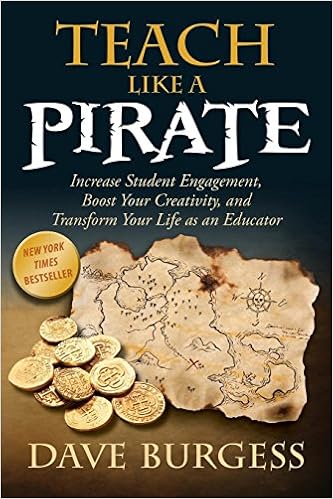
 Teach Like a PirateTeach Like a Pirate by Dave Burgess

A couple of years ago, I attended Burgess's keynotes at the P20 conference in Twin Falls. This passionate educator uses the acronym PIRATE to inspire teachers to teach with creativity every day for student engagement and achievement. As the book's Amazon page claims, you'll learn how to:

  •  Tap into and dramatically increase your passion as a teacher
  •  Develop outrageously engaging lessons that draw students in like a magnet 
  •  Establish rapport and a sense of camaraderie in your classroom
  •  Transform your class into a life-changing experience for your students 
As a writer, I'm always looking for ways to increase the suspense in my prose. Turns out, suspense is vital for student engagement, too. Burgess walks you through it in a not-scary way, even (and especially) if you think you're "not creative."


Powerful Teaching: Unleash the Science of Learning by Pooja K. Agarwal, Ph.D., and Patrice M. Bain, Ed.S.


I'm currently reading this 2019 book, and I'm taking careful notes on the research-based "power tools" and how to use them in my teaching. It's so refreshing to learn that cognitive science shows that many teaching strategies we're already using are dead-on, but there are ways to leverage the science of learning to increase student understanding far beyond our expectations. I highly recommend this book for all teachers in all disciplines and grade levels. You can view excerpts from the book here!

Unlocking English Learners' Potential by Diane Staehr Fenner and Sydney Snyder

This one's on my to-be-read list. Even though my small district has a low population of English learners, we need practical tools to support each student as he or she learns. This fall I'll be presenting a professional development refresher on strategies for teaching ELs to my school staff. While I could just use last year's slideshow as a springboard, I want to dig deeper and have plenty of information and research at the ready. Not to mention energizing my presentation! If any of you have read this book, tell us what you think.


Please share in the comments any great teacher books you have found energizing!


For more summer reads, check out these posts:

Who Is My Neighbor? Better Information Means Better Compassion
Words To Live By, A New Book By Dalene Parker and Linda Gilden
Conference Time and A Few Good Books
Balance and Boundaries

Visit my store, Brevity, on Teachers Pay Teachers and follow me, Amy, on Goodreads!